10 Modulo de transferencia de calor & ingles terms
Investigate and analyze the words that will be used in this unit for a better compression on heat transfer.
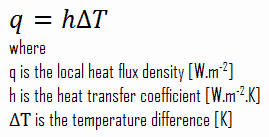
Convection heat transfer coefficient
Noun.
It can be defined as the rate of heat transfer between a solid surface and a fluid per unit area per unit temperature difference.
Example: It is an experimentally determined parameter whose value depends on all variables that influence convection, such as surface geometry, nature of fluid motion, fluid properties, and bulk fluid velocity.
en: Coeficiente de transferencia de calor por convección.
Critical Reynold’s number
Noun.
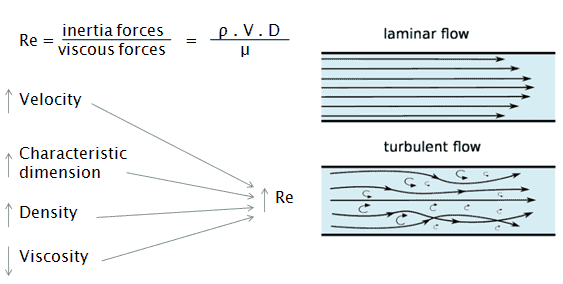
The critical Reynolds number is associated with the laminar-turbulent transition, in which a laminar flow becomes turbulent.
Example: It is used to know the characteristics of a flow. It is a dimensionless value, that is, it has no units. A small number, 《<2000) indicates that the flow is laminar, while a high number indicates that the flow is turbulent.
en: Número crítico de Reynolds.
Friction Coefficient
Noun.
Is the ratio between the sliding force and the retention force exerted by two surfaces in contact.
Example: Disc brake performance has shown to be dependant upon the geometry of the disc and pads, and the FRICTION COEFFICIENT between the pad material and the rotor.
Kinematic viscosity
Noun.
It is a measure of the internal resistance of a fluid to flow under gravitational forces. It is determined by measuring the time in seconds required for a fixed volume of fluid to flow by gravity a known distance.
Example: This is not as intuitive as absolute viscosity as it would appear, take air as an example which under standard conditions has a higher KINEMATIC VISCOSITY than water owing to its lower density.
en: Viscosidad cinemática.
Laminar flow
Noun.
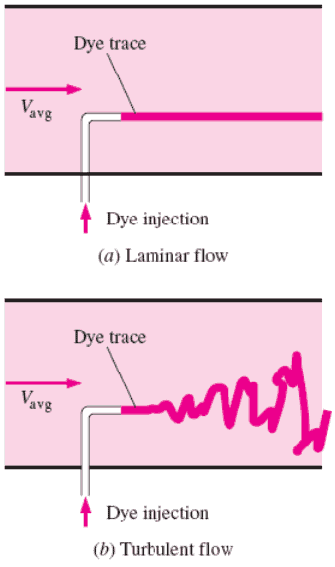
Laminar flow is the movement of a fluid when it is ordered, stratified or smooth, this fluid moves in parallel sheets without intermingling and each fluid particle follows a smooth path, called a current line.
Example: LAMINAR FLOW is dominated by viscosity forces and the flow is parabolic.
en: Flujo laminar.
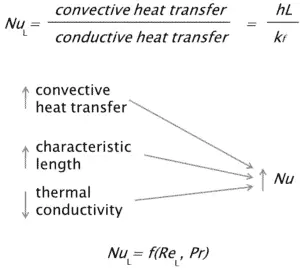
Nusselt number
Noun.
Is a dimensionless number that measures the increase in heat transfer from a surface through which a fluid flows (heat transfer by convection) compared to the heat transfer if it occurred only by conduction.
Example: There are many empirical correlations expressed in terms of the Nusselt number, for example, flat plates, cylinders, inside pipes, etc., which generally evaluate the mean Nusselt number on a surface.
en: Número de Nusselt
Prandtl number
Noun.
It is a dimensionless number, named for its inventor, the German engineer Ludwig Prandtl. The Prandtl number is defined as the ratio between the momentum diffusivity and the thermal diffusivity.
Example: Air at room temperature has a Prandtl number of 0.71 and for water at 18 ° C it is around 7.56, which means that thermal diffusivity is more dominant for air than for water.
en: Número de prandtl
Reynold number
Noun.
Is a dimensionless number used in fluid mechanics, reactor design, and transport phenomena to characterize the motion of a fluid. Its value indicates whether the flow follows a laminar or turbulent pattern.
Example: For example, a flow with a Reynolds number around 100,000 (typical in the movement of a small aircraft, except in areas close to the boundary layer) expresses that the viscous forces are 100,000 times less than the convective forces, and therefore therefore those can be ignored.
en: Número de Reynold.
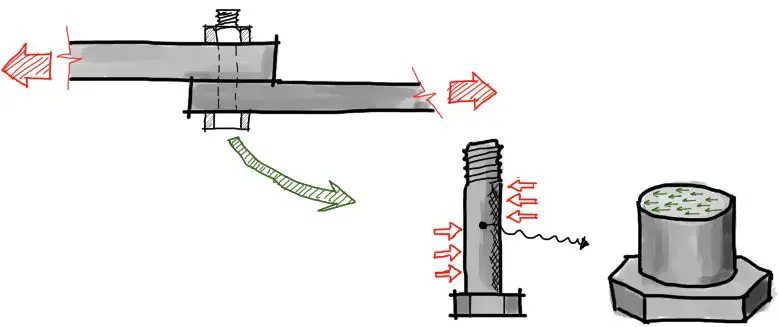
Shear stress
Noun.
The shear stress is the internal or resultant stress of the stresses parallel to the cross section of a mechanical prism.
Example: The shear stress diagram of a prismatic part is a function that represents the distribution of shear stresses.
en: Esfuerzo cortante.
Turbulent flow
Noun.
It is one in which the particles move in parallel layers, or sheets, without invading the path of the other particles.
Example: Large inertial forces seem to tend toward a TURBULENT FLOW being present in comparison to a high viscosity which oppositely tends to create a rather more laminar flow.